For Personal Injury Law Firms
Service of process for personal injury law firms
Serve defendants faster, keep every case on track, and get court-ready affidavits.
Proof provides reliable service of process for plaintiffs’ firms, including delivery of subpoenas, summonses, and complaints, by a network of vetted process servers. Plaintiff-side attorneys, personal injury law firm paralegals, case managers, and legal ops professionals use Proof to serve defendants on time, with affidavits that hold up in court.
Scale your personal injury firm’s operations with Proof.
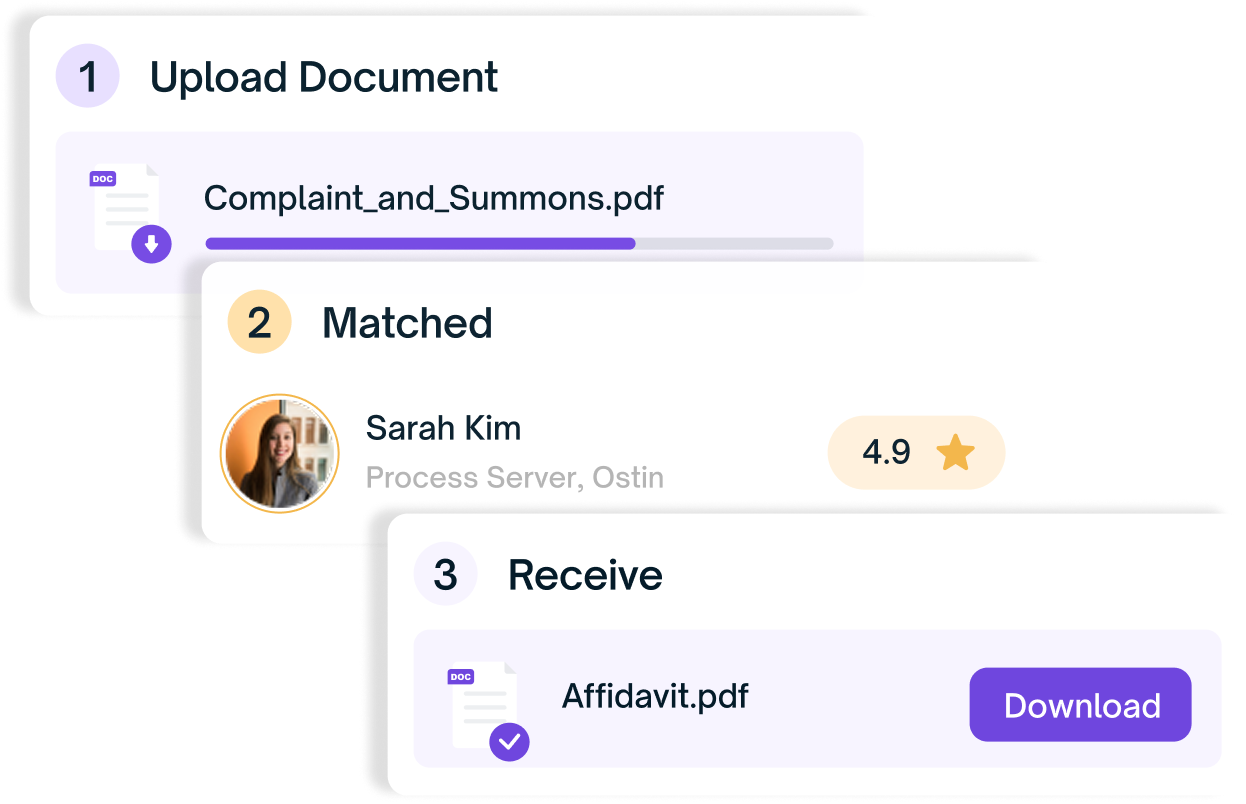





A personal injury law practice may have hundreds of open matters, each with its own defendants, courts, and deadlines. Service of process is often where cases stall: a bad address, a missed attempt, or an affidavit that doesn’t hold up.
You can avoid unnecessary delays.
Proof’s service of process platform offers:


Vetted process servers
Each independent process server in our network has gone through a rigorous vetting process, including a comprehensive background check.

Fewer failed attempts
Proof checks addresses in real time and flags missing unit numbers, P.O. boxes and USPS-flagged vacant addresses before a serve is submitted.

Affidavits that hold up
Every attempt is logged with GPS location, photos, timestamps, and notes from the process server in the field. Court-specific, notarized affidavits are generated automatically.

Less data entry
Proof Autofill™ reads your complaint and summons, identifies the parties to be served, and pulls courts and addresses; you can create a serve in 60 seconds.

Case management integrations
Proof integrates easily with SmartAdvocate, Filevine, Litify, Clio, MyCase, or custom API. Start serves, track status, and receive affidavits and invoices inside your existing workflows.

Transparent pricing
Proof pricing is pay-per-serve with no subscription fees, contracts, or hidden charges.
With Proof, service of process for personal injury law firms is centralized in one platform built for litigation teams.
What documents do personal injury practices need served?
Plaintiff-side law firms rely on process servers at every stage of a case.
Whether your clients were hurt in car accidents, harmed by medical malpractice, injured on the job or on an unsafe property, or sickened by a defective product or exposure to asbestos, Proof provides the fast, reliable service of process your cases depend on.
Starting the lawsuit
Summons and complaint
Amended complaints and third-party complaints
Notice of claim
Out-of-state defendants
Gathering evidence
Records subpoenas (subpoenas duces tecum) to non-parties for:
medical and billing records
police and accident reports
employment and wage records
phone records
maintenance logs
surveillance or dashcam footage
Deposition subpoenas
Trial subpoenas
Preservation (spoliation) letters
Routine discovery between parties, like interrogatories and document requests, usually goes to opposing counsel by mail or e-filing. Non-parties, however, generally must be personally served with a subpoena.
During litigation
Orders to show cause
Court orders
After a verdict or settlement
Judgment enforcement papers, such as information subpoenas, restraining notices, wage garnishments, and bank levies, served on the defendant or on banks and employers
Integrity built into every serve
Fraud protections in the platform detect GPS spoofing, jailbroken devices, device sharing, and duplicate accounts in real time. A compliance team with process serving experience reviews attempts and documentation. If an issue arises, Proof notifies you, investigates, removes the server, and re-serves at no cost.
Real-time visibility for attorneys and staff
Get live updates as attempts happen, with mapped GPS verification, photos, timestamps and notes. Chat directly with your process server and a Proof Specialist, available 24/7.
Skip tracing available when a defendant has moved
Proof’s skip tracing service combines premium databases, open-source intelligence and human verification to find a defendant’s current address.
Substituted service or alternate methods when personal service fails
Where allowed by law, substituted service (sometimes referred to as “sub-service”) is the delivery of documents to someone other than the named defendant.
Reporting your personal injury firm can use
Access all of your reporting in one dashboard, export your data for filing, and track key performance metrics across your caseload.
Enterprise-grade security
Proof is SOC 2 Type II compliant, so sensitive client and case data is protected by audited controls.
Read about our commitment to integrity in service of process.

SEAMLESS INTEGRATION
The Proof API
Proof works within your practice’s workflow.
Efficiency in personal injury law firms requires a unified tech stack. Integrate Proof directly with our pre-built integrations with Litify, SmartAdvocate, Filevine, MyCase, and Clio.
Custom integrations available through the Proof API. Explore our technical documentation to see how easily Proof connects to your database and internal systems.
Ready to scale your
personal injury law practice with Proof?
FAQ
Frequently asked questions about service of process for personal injury cases
It depends on the court. In federal court, Rule 4(m) of the Federal Rules of Civil Procedure generally requires service within 90 days after the complaint is filed. State deadlines vary. Missing a court deadline can lead to dismissal, which is especially risky when the statute of limitations has run.
In many states, any adult who is not a party to the case can serve process. Some states and cities, including California, Texas, and New York City, require process servers to be registered, certified, or licensed. We recommend using process servers who know the rules for the relevant jurisdiction.
If a defendant can’t be found or is avoiding service, options include: skip tracing to locate a current address, repeated attempts at different times, and substituted service where state law allows. If those options fail, a court may authorize alternative service, such as service by publication or email.
An affidavit of service, also called a proof of service, is a sworn statement from a process server describing when, where, how, and on whom documents were served. Courts rely on affidavits of service to confirm a defendant received proper notice.
Proof charges per serve, with no subscriptions or contracts. See Proof’s state-specific pricing information.