Personal Service vs. Substituted Service
What Paralegals Need to Know
In the high-stakes world of litigation, the “clock” often starts with a single act: the service of process. For paralegals and legal administrators, managing this stage of the litigation lifecycle requires more than just administrative diligence—it requires a solid understanding of the procedural distinctions between personal and substituted service.
Mistakenly relying on the wrong method for service of process can lead to a motion to dismiss, significant case delays, and potential malpractice risks. Here is a definitive guide to navigating these two primary methods to ensure your law firm remains compliant.
The Gold Standard: Personal Service of Process
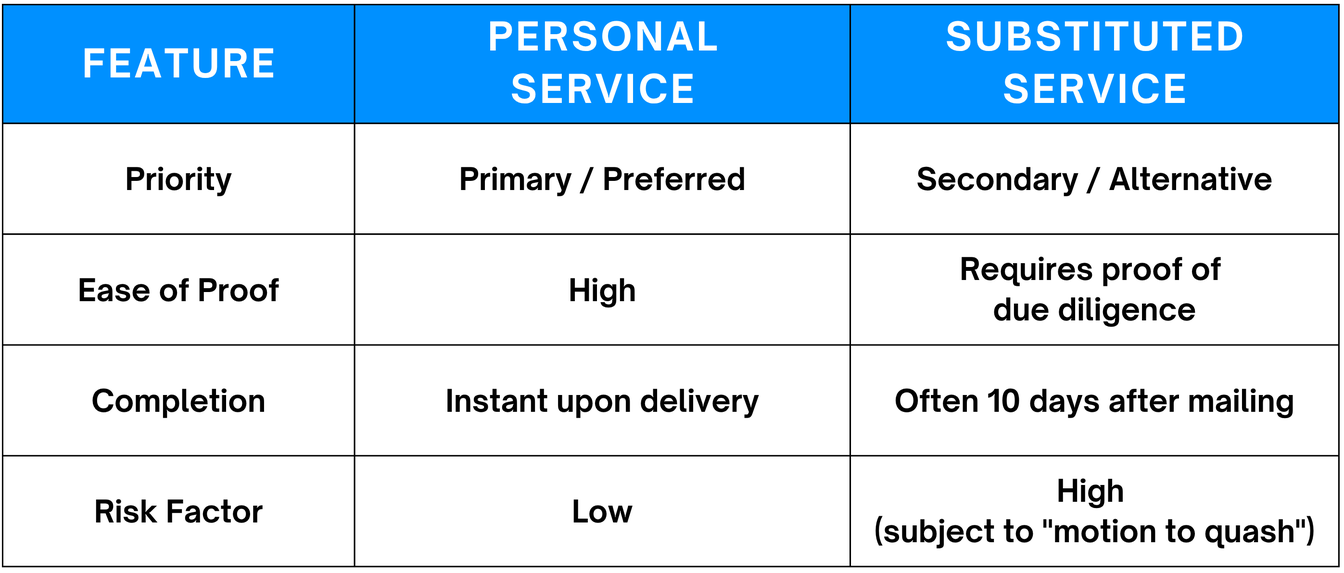
Personal service occurs when the process server physically delivers the legal documents directly into the hands of the named defendant or an authorized agent. Across almost every jurisdiction in the United States, this is considered to be the gold standard of notice.
Why It Matters
Personal service is the most defensible form of notice. Because the server identifies the individual and physically hands them the summons and complaint, the defendant has a significantly higher burden when attempting to claim they were never notified.
Pro-Tip for Paralegals: When initiating service of process, provide your server with as many details as possible—including physical descriptions, known schedules, and photos—to ensure a positive identification that will hold up under forensic scrutiny.
The Alternative: Substituted Service of Process
Substituted service (sometimes referred to as “sub-service”) allows for the delivery of documents to someone other than the named defendant. This is typically an adult resident at the defendant’s home.
The "Due Diligence" Requirement
Unlike with personal service, substituted service of process is usually not a first-choice option. Most states require a demonstration of due diligence before sub-service is considered valid. This means that the process server must have made multiple documented attempts at personal service at different times of the day before resorting to leaving the papers with a co-resident.
The Mailing Requirement
In many jurisdictions, substituted service is a two-step process. Once the papers are left with a suitable person at the defendant’s residence, a copy must also be mailed to the defendant via first-class mail. Service of process is not deemed complete until both steps are documented.
Key Differences and Procedural Risks
Scaling Your Service of Process Strategy
For law firms managing high-volume litigation, the manual tracking of attempts for substituted service can be a major bottleneck. Technology platforms like Proof solve this by providing real-time, forensic-level data for every serve.
By utilizing a technology platform to manage firm-wide service of process, paralegals can instantly verify:
GPS and Time-Stamping: Proving the server was at the location for every attempt.
Affidavits of Due Diligence: Automatically generating the necessary documentation to justify substituted service to the court.
Chain of Custody: Ensuring a digital audit trail that protects the firm from procedural challenges.
Due Diligence Matters
Understanding the nuances between personal and substituted service of process is essential for any paralegal focused on risk management. While personal service remains the preferred method, mastering the "due diligence" requirements of substituted service ensures that your case moves forward even when a defendant is evasive. By combining procedural knowledge with advanced legal technology, firms can ensure that every serve is a proper and legal serve.
As rules for service of process are different in each state, be sure to check your state’s Judicial Branch website or work with a trusted partner like Proof.
Ensure your service of process is bulletproof. Speak to a professional at Proof about due diligence for law firms.