How to Scale Collections in Serve-First States
Improving Outcomes with Accuracy, Compliance, and Transparency
Serve-first jurisdictions offer collections firms a meaningful operational edge—but only if your process service infrastructure is built to handle volume, meet strict jurisdiction-specific deadlines, and give every stakeholder clear visibility into what’s happening at every step.
The ability to handle volume without sacrificing accuracy, stay ahead of jurisdictional compliance requirements, and give attorneys and staff the visibility they need to make fast, confident decisions is critical for scaling a collections practice.
The Serve-First Advantage—and Its Constraints
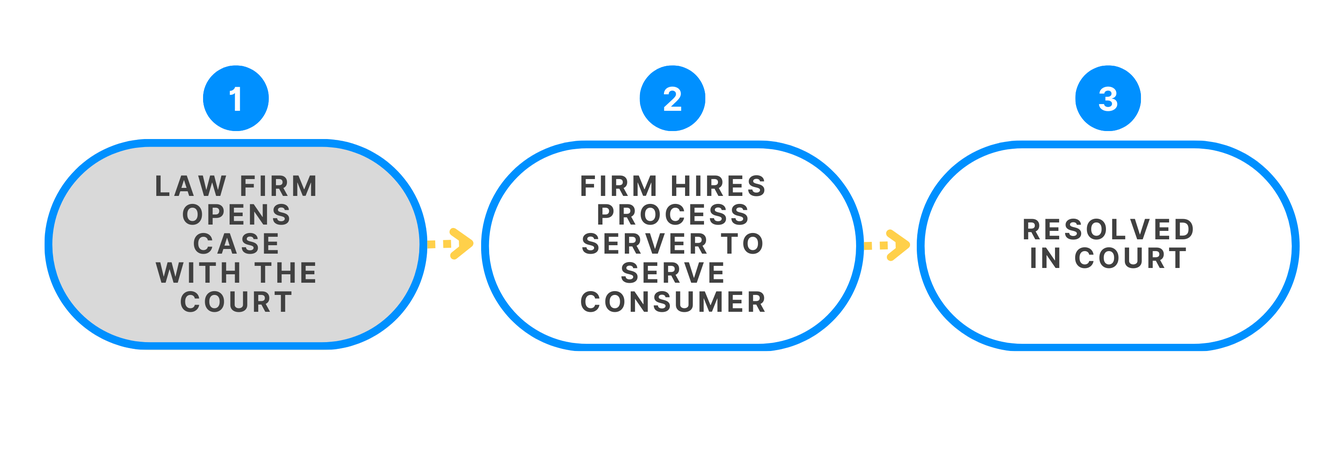
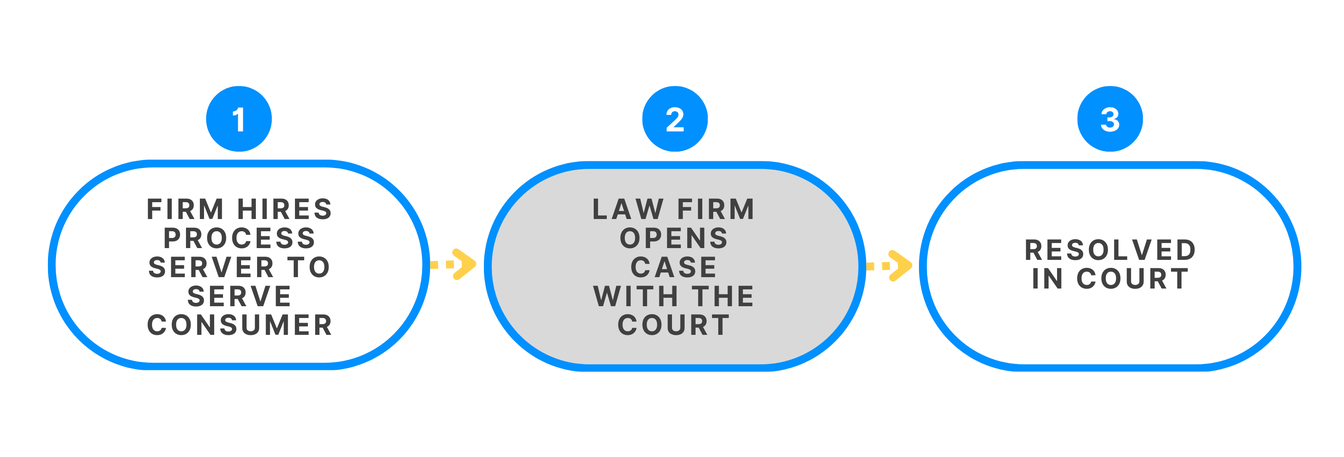
In a file-first state, the court comes first: the firm files, pays the filing fee, and then serves the consumer. In serve-first states, the sequence is reversed. The firm engages a process server, the consumer is served, and the affidavit of service is returned before the case is ever filed with the court. Filing—and its associated costs—only happens after service is confirmed.
That reversal creates a narrow but valuable window. Once a consumer has been personally served, their attentiveness is at its peak—they’re actively weighing their options. A firm that can reach that consumer immediately after service, before the case is filed, has a genuine opportunity to negotiate a stipulation, settlement, or payment plan without incurring court costs at all.
As of this writing, collections forms in “serve-first states” include Colorado, Maine, Minnesota, North Dakota, Utah, and Vermont have the clearest path to scale.
File-First workflow
Serve-First workflow
How Proof Supports Collections Law Firms in Serve-First States
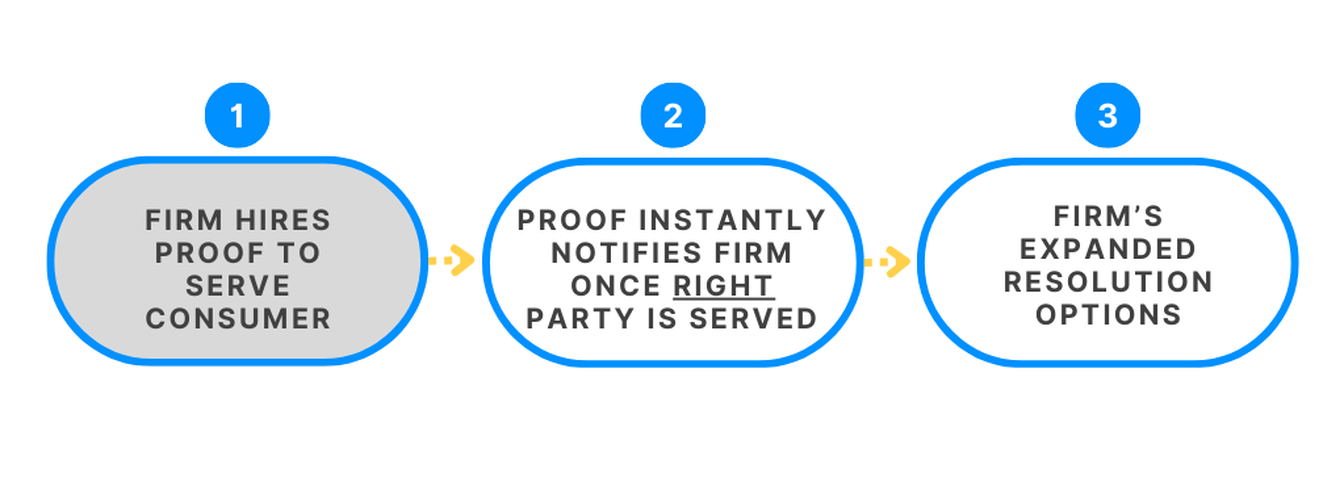
For high-volume collections practices, the math compounds quickly: fewer filings, lower costs, faster resolutions, and better performance metrics across the board.
But the constraints are real. Serve-first deadlines vary significantly by state and leave little room for error. For example, Minnesota gives firms up to a year after service to file with the court. North Dakota compresses that to 20 days, after which the service itself becomes void. Utah enforces a 10-day window with strict procedural requirements.
In the tightest jurisdictions, any lag in the service workflow—slow affidavit turnaround, communication gaps, missed status updates—doesn’t just forfeit the settlement window; it can invalidate the serve entirely.
Serve-First States with the Clearest Path to Scale
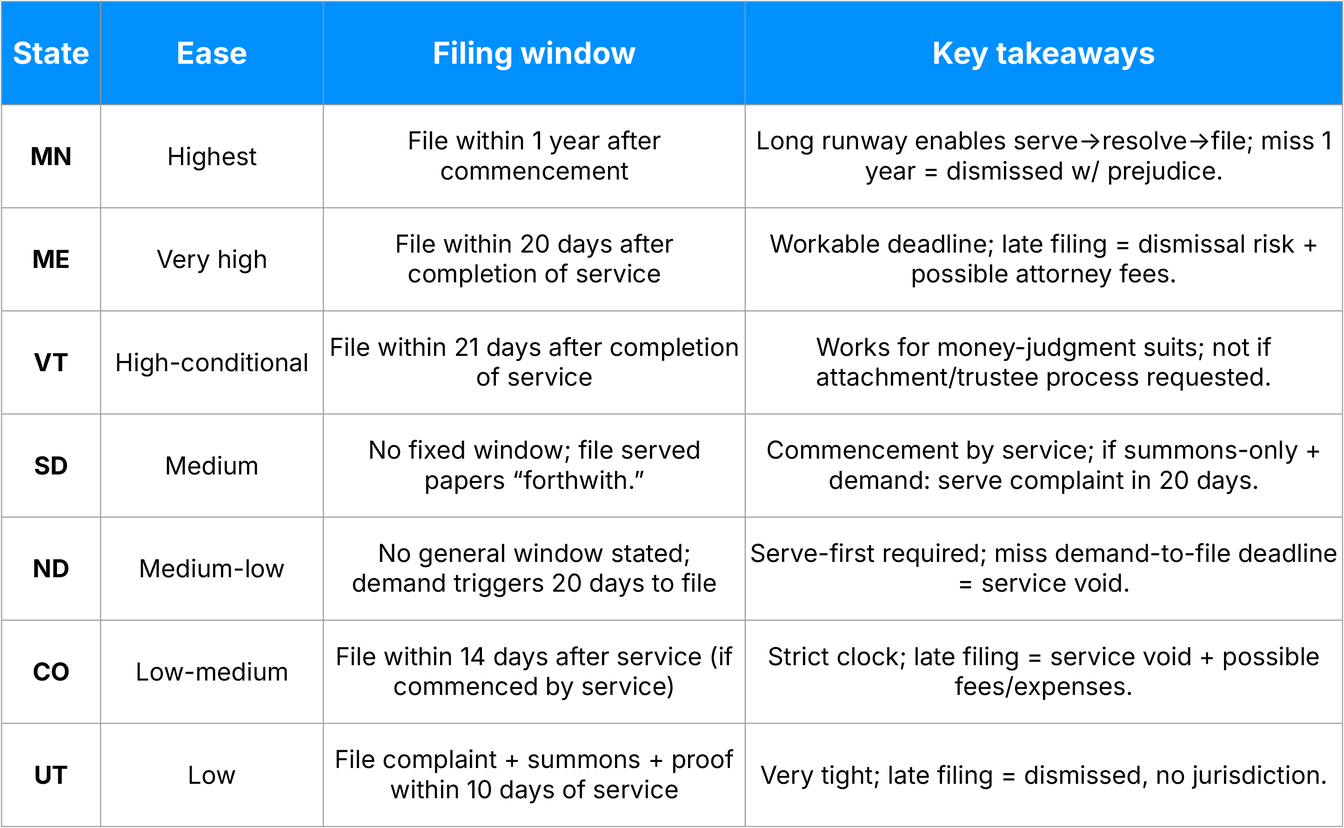 For information only—not legal advice. Please verify local rules.
Accuracy: Serving the Right Party, the Right Way
Inaccurate service is one of the most expensive problems a collections firm can have. Serving the wrong party wastes time and money and can expose the firm to legal risk.
Proof addresses this at multiple levels. The platform uses AI to verify document accuracy and flag compliance issues before a serve is attempted. Skip tracing, address verification, and address scoring tools help ensure the firm is working with the best available location data before dispatching a server.
When an address turns out to be incorrect—as in cases where a neighbor confirms the subject has moved—the process server immediately flags the job and routes it to the customer for approval of next steps before any further attempts are made.
Operational and Financial Impact
When collections law firms engage with a service of process partner like Proof, they may benefit from faster notification of RPC, converting accounts to payers inside the pre-litigation window; earlier resolutions that require less back-office labor; and better KPIs and performance metrics, which ultimately should lead to more volume.
Proof Supports Bulk Job Creation for Collections Law Firms
For collections firms running jobs in batches—the norm for high-volume practices—Proof supports bulk job submission via spreadsheet with corresponding PDFs, allowing for hundreds or thousands of serve requests to be ingested and created with just a few clicks.
Proof has a dedicated team of collections professionals available to handle job loading on the firm’s behalf. That team has direct experience working in collections law firms, which means they understand the format variations, exporting quirks, and workflow nuances that generic process server platforms often don’t.
Compliance: Meeting Deadlines Without Manual Oversight
Jurisdictional compliance in serve-first states is not a set-and-forget problem. Deadlines are short, rules vary, and the consequences of missing them—voided service, wasted filing fees, restarted workflows—hit the bottom line directly.
Proof’s platform is built to reduce that risk through automation and real-time monitoring. Every job has a visible timeline showing when the first attempt is expected, where the job currently stands, and which actions are pending.
Proof maintains SOC 2 Type II compliance for information security in order to mitigate risk and preserve confidentiality.
Software Integrations to Save Time and Avoid Errors
Proof’s platform integrates easily with e-filing systems to support new case filings, affidavit filings, and miscellaneous filings, with accountability systems designed to keep deadline adherence on track across a large portfolio of active jobs.
For technically sophisticated firms, Proof has a mature, well-documented API that allows serves to be initiated without ever leaving the firm’s own application.
Collections law firms that use Vertican (CLS and QLAW), Cogent, Simplicity, JST can easily integrate with the Proof portal for seamless job creation, real-time access to serve data, and ease of tracking and billing without potential for human error. The same is true for Clio, Filevine, Litify, or MyCase.
Transparency: Full Visibility Across Every Job
For firms managing hundreds or thousands of active matters, visibility is not just nice to have; it’s an operational necessity. Proof’s platform surfaces the full status of every job in a single, filterable dashboard. Each attempt is logged with geolocation data, photographs, and time and date stamps.
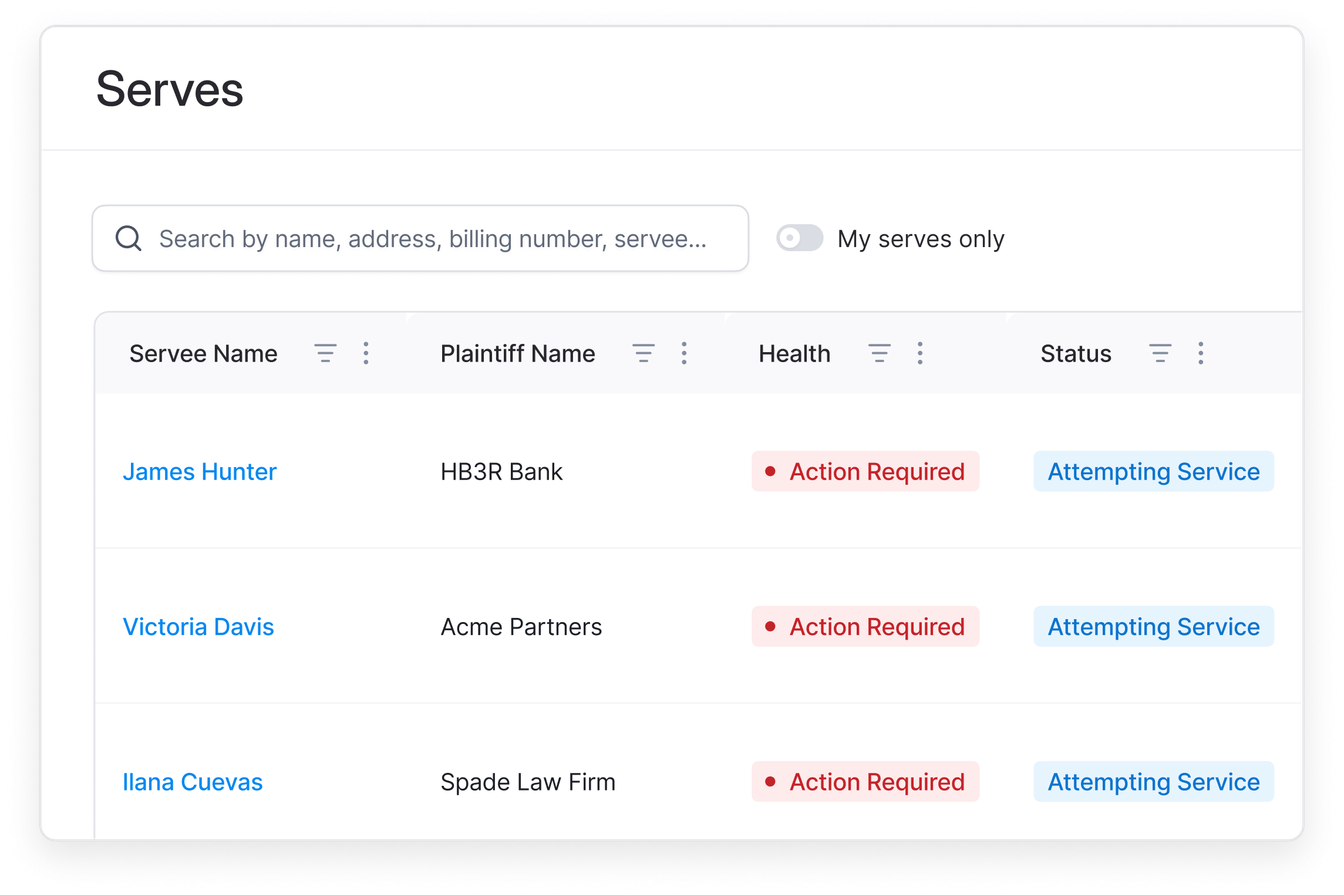
A live three-way chat connects the firm, the Proof team, and the server, with a unified history view available when multiple servers have worked a single job. Every communication, outcome, and status change is preserved in a detailed audit trail.
That audit trail exists in collections work specifically because the evidentiary requirements around service are paramount. When a case proceeds to litigation, a well-documented, timestamped record of every attempt—including failed ones—is essential.
Whether its a paralegal checking the status of a job on a Tuesday morning or an attorney who is preparing to go to court that afternoon, there is transparency throughout the process.
Serve-First States Can Be High-Yield Territories
Serve-first states represent a genuine strategic opportunity for collections firms. Realizing that opportunity at scale requires more than knowing the rules. It requires infrastructure that delivers accurate serves, stays ahead of compliance rules and deadlines, and gives every member of the team the transparency to act quickly and confidently.
That combination is what separates firms that succeed in serve-first states from those that merely operate in them.
Speak to a Collections expert at Proof.
This article is based on a webinar presented by Proof on February 18, 2026. It is informational only and does not constitute legal advice. Rules vary by jurisdiction; consult counsel to verify applicability.